
Table of Contents
Introduction
A serious cybersecurity threat has emerged that targets one of the most sensitive categories of personal data: French national health insurance records.
A threat actor operating on the dark web is allegedly selling a large database containing confidential health insurance records belonging to national identifiers across France. The claim first surfaced on dark web forums and has since triggered immediate concern among cybersecurity researchers, healthcare organizations, and data protection authorities.
If confirmed, this breach could become one of the most alarming healthcare data exposure events in French cybersecurity history in 2026.
What Was Claimed?
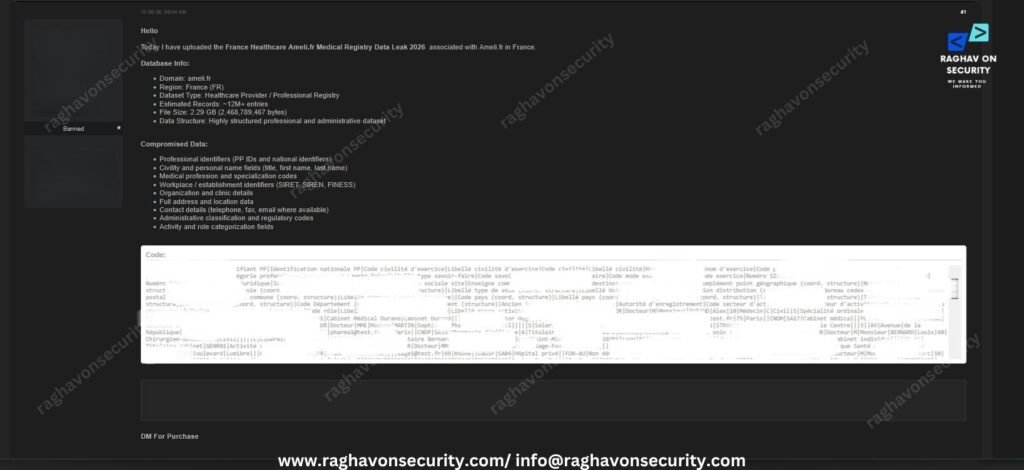
According to the post, the stolen database contains:
- Domain: ameli.fr
- Region: France (FR)
- Dataset Type: Healthcare Provider / Professional Registry
- Estimated Records: ~12M+ entries
- File Size: 2.29 GB (2,468,789,467 bytes)
- Data Structure: Highly structured professional and administrative dataset
Compromised Data:
- Professional identifiers (PP IDs and national identifiers)
- Civility and personal name fields (title, first name, last name)
- Medical profession and specialization codes
- Workplace/ establishment identifiers (SIRET, SIREN, FINESS)
- Organization and clinic details
- Full address and location data
- Contact details (telephone, fax, email, where available)
- Administrative classification and regulatory codes
- Activity and role categorization fields
Who is affected?
This alleged breach directly impacts “France Nationals” across France and its broader territories.
Healthcare data is among the most sensitive personal information a person can possess. Unlike passwords or credit card numbers, medical records and health insurance identifiers cannot simply be changed or cancelled.
Organizations across France should treat this development as a serious threat requiring immediate internal review. Individuals potentially at risk include:
- Citizens who have previously filed national health insurance claims.
- Patients who have interacted with affiliated healthcare providers.
- Employers and organizations are linked to group health insurance schemes.
Why Healthcare Data Is Extremely Valuable on the Dark Web?
Health insurance records carry significantly higher black market value than standard financial data. Cybercriminals actively seek this type of information because it enables multiple forms of fraud simultaneously. This makes healthcare breaches uniquely devastating.
The damage extends far beyond immediate financial loss and can follow victims for years after the initial exposure. Stolen health insurance data can be exploited for:
- Medical identity theft – fraudulently claiming healthcare services using a victim’s insurance credentials.
- Prescription fraud – obtaining controlled medications under stolen patient identities.
- Insurance claim fraud – filing false reimbursement claims against legitimate policyholders.
- Targeted phishing attacks – crafting highly convincing emails using personal medical details.
- Social engineering operations – manipulating victims using sensitive health information as leverage.
GDPR Implications for French Organizations
This alleged breach carries significant General Data Protection Regulation (GDPR) implications for organizations operating across France and the European Union.
Under GDPR Article 9, health data is classified as a special category of personal data requiring the highest level of protection. Organizations that fail to adequately protect this information face:
- Heavy fines, which can easily go above their global annual turnover.
- Mandatory breach notification to CNIL (France’s national data protection authority) within 72 hours.
- Potential civil liability claims from affected individuals.
- Serious long-term reputational damage.
What Should Affected Individuals Do Right Now?
- Monitor your health insurance account for any unauthorized claims or unusual activity.
- Contact your national health insurance provider to report a potential compromise.
- Enable additional verification on your health insurance portal if available.
- Check your email on HaveIBeenPwned.com for credential exposure.
- Be extremely cautious of unsolicited calls or emails referencing your medical history.
- Report suspicious activity immediately to CNIL in France or your national data protection authority.
- Avoid clicking links in any emails claiming to be from your health insurance provider.
- Inform your doctor or healthcare provider so they can flag your records for potential fraudulent activity.
What Do Cybersecurity Experts Say?
Cybersecurity professionals consistently stress that deep web data sale listings must be treated seriously, even before official confirmation arrives. Researchers note that threat actors selling healthcare records publicly are typically motivated by:
- Direct financial gain through data sale to multiple criminal buyers.
- Insurance fraud networks are seeking verified patient credentials.
- Ransomware preparation using stolen data as leverage for future extortion campaigns.
Organizations that discover their data appearing on criminal marketplaces should immediately:
- Engage their incident response team.
- Notify CNIL and relevant EU regulatory authorities.
- Begin forensic investigation procedures without delay.
- Communicate transparently with affected patients and policyholders.
Conclusion
The alleged sale of national health insurance records on the deep web is a deeply alarming development for France and the broader European healthcare ecosystem. Health data is irreplaceable. Once exposed, the consequences can affect victims for years, through medical fraud, identity theft, targeted manipulation, and regulatory complications.
Every healthcare organization, insurance provider, and government health authority across France must treat this incident as an urgent call to action.
Cybersecurity preparedness in the healthcare sector is no longer optional. It is a fundamental obligation to every patient, policyholder, and citizen whose most sensitive personal information sits inside these systems.