

Table of Contents
Introduction
A ransomware group has allegedly leaked sensitive customer records belonging to MagMutual (magmutual[.]com), an insurance company operating out of Atlanta, Georgia, on a dark web forum.
The leaked data was reportedly posted on the deep web. Shortly afterward, cybersecurity researchers and threat intelligence teams identified the information while monitoring underground criminal activity. However, unlike typical ransomware operations that encrypt data and demand payment, this group has reportedly made the stolen records freely accessible to anyone on the dark web.
Furthermore, the group claims to have obtained a large number of sensitive records containing critical customer and business information. These records allegedly belong to individuals and organizations across Atlanta, Georgia, and the broader United States.
If confirmed, this incident could therefore become one of the most serious insurance-sector data breaches to affect Georgia and the US in 2026. As a result, the potential consequences for affected policyholders and corporate clients could be truly devastating.
What Was Claimed?
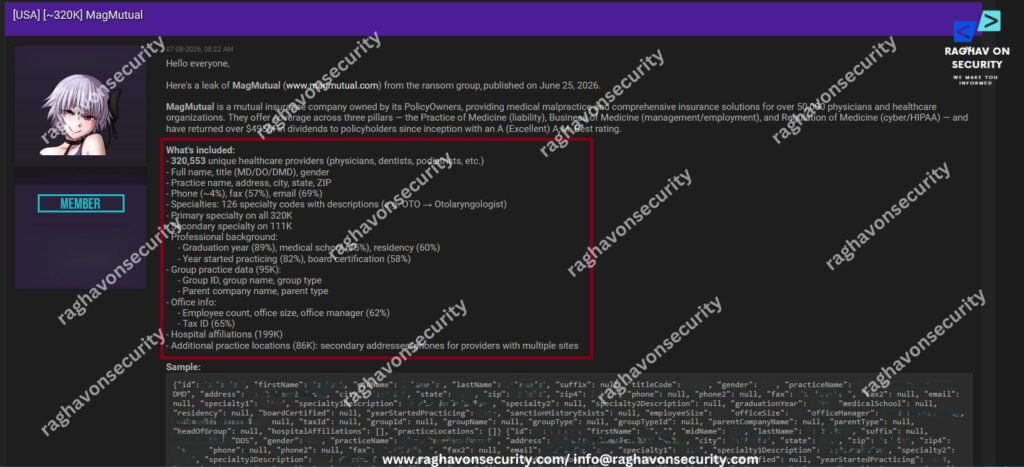
The ransomware group publicly posted the alleged dataset on a deep web forum.
Dataset Overview:
- What’s included:
- 320,553 unique healthcare providers (physicians, dentists, podiatrists, etc.)
- Full name, title (MD/DO/DMD), gender
- Practice name, address, city, state, ZIP
- Phone (~4%), fax (57%), email (69%)
- Specialties: 126 specialty codes with descriptions (e.g., OTO → Otolaryngologist)
- Primary specialty on all 320K
- Secondary specialty on 111K
- Professional background:
- Graduation year (89%), medical school (75%), residency (60%)
- Year started practicing (82%), board certification (58%)
- Group practice data (95K):
- Group ID, group name, group type
- Parent company name, parent type
- Office info:
- Employee count, office size, office manager (62%)
- Tax ID (65%)
- Hospital affiliations (199K)
- Additional practice locations (86K): secondary addresses/phones for providers with multiple sites
Who Is the Ransomware Group Behind This?
The group responsible for this leak operates under the name Leaknet.
Who Is Affected?
This alleged breach directly impacts customers and corporate clients of MagMutual operating across Atlanta, Georgia, and the United States.
Insurance companies hold some of the most sensitive personal and financial data of any industry. A breach of this nature could expose:
- Individual policyholders across Atlanta and Georgia
- Corporate clients with group insurance policies
- Healthcare insurance beneficiaries whose medical records are referenced
- Business owners carrying commercial insurance policies
- Employees covered under employer-sponsored insurance schemes
Why Insurance Company Data Is Extremely Valuable on the Dark Web
Insurance records rank among the most sought-after datasets on criminal underground markets. Therefore, it is no surprise that cybercriminals actively target insurance companies. This is mainly because their databases often contain a valuable combination of personal, financial, and medical information.
Moreover, when this sensitive information is stolen, it can be used for identity theft, financial fraud, and other cybercrimes. As a result, insurance data breaches can create serious and long-term risks for both individuals and organizations.
Stolen insurance data enables multiple forms of fraud, including:
- Identity theft using Social Security Numbers and government ID details
- Insurance fraud – filing false claims using stolen policyholder identities
- Medical identity theft – obtaining healthcare services under a victim’s insurance coverage
- Financial fraud – exploiting banking details linked to premium payment records
- Targeted phishing campaigns – crafting convincing emails using personal policy details
- Business Email Compromise (BEC) – targeting corporate clients using leaked company information
For Atlanta and Georgia residents specifically, the combination of Social Security Numbers, home addresses, and financial details can create ideal conditions for long-term identity theft. As a result, victims may face serious financial consequences that can continue for years.
- Legal and Regulatory Implications for Atlanta and Georgia
- This alleged breach carries serious legal and regulatory consequences under multiple US frameworks.
Affected organizations and individuals should be aware of:
- HIPAA (Health Insurance Portability and Accountability Act) – If health insurance or medical information was part of the leaked dataset, then investigations into potential HIPAA violations may follow. In addition, organizations could face penalties ranging from $100 to $50,000 per violation, depending on the level of negligence involved.
- Georgia Personal Identity Protection Act – Under Georgia state law, organizations that experience a data breach must notify affected residents without unreasonable delay. Therefore, failure to comply with these requirements can result in significant legal liability.
- FTC Act and Consumer Protection Laws – Furthermore, the Federal Trade Commission (FTC) actively investigates data breaches involving consumer financial information. As a result, insurance companies that fail to maintain adequate security standards could face potential FTC enforcement actions.
- SEC Disclosure Requirements – Finally, if MagMutual is a publicly traded company or serves publicly traded clients, SEC cybersecurity disclosure obligations may require prompt public reporting of certain cybersecurity incidents. However, the specific requirements depend on the company’s circumstances and the nature of the incident.
What Should Affected Customers Do Right Now?
If you believe your insurance data may have been compromised in this breach, take these immediate steps:
- Contact MagMutual directly to confirm whether your records were part of the leaked dataset.
- Place a fraud alert on your credit file with all three major credit bureaus – Equifax, Experian, and TransUnion.
- Consider a credit freeze to prevent new accounts from being opened in your name.
- Monitor your insurance account for any unauthorized policy changes or claims.
- Check your Social Security Number exposure on HaveIBeenPwned.com and the FTC’s IdentityTheft.gov.
- Report suspicious activity to the FBI Internet Crime Complaint Center (IC3) at ic3.gov.
- Contact Georgia’s Insurance Commissioner if you believe your insurance rights have been violated.
- Consult a legal professional if you believe you have suffered financial harm as a result of this breach.
What Do Cybersecurity Experts Say?
Cybersecurity professionals consistently stress that ransomware leak site postings must be treated as serious threats – even before official organizational confirmation arrives.
Researchers identify three primary scenarios following a ransomware data dump:
- Immediate exploitation by criminal buyers who download and monetize the data instantly.
- Secondary ransomware campaigns targeting individuals whose data appears in the leak.
- Long-term identity fraud operations that may not surface for months or even years after initial exposure.
Organizations in Atlanta and across Georgia that discover their data appearing on dark web forums should immediately:
- Activate their incident response plan.
- Notify the FBI Cyber Division and relevant federal agencies.
- Engage a forensic cybersecurity team to determine the full scope of the breach.
- Communicate transparently with all affected policyholders.
- Consult legal counsel regarding HIPAA, Georgia state law, and FTC compliance obligations.
Conclusion
The alleged leak of MagMutual insurance company records by a ransomware group is a deeply serious cybersecurity incident. Therefore, it demands immediate attention from affected customers, business partners, and regulatory authorities across Atlanta, Georgia, and the United States.
Insurance companies are trusted with some of the most sensitive personal and financial data their customers will ever share. However, when that trust is broken—whether through a ransomware attack, misconfiguration, or insider threat—the consequences can follow victims for years.
Furthermore, no insurance company or policyholder across Atlanta or Georgia should consider themselves immune to the growing threat of ransomware-driven data exposure in 2026. As cybercriminal groups continue to evolve their tactics, the risk of sensitive information being stolen and exposed remains a serious concern.
For this reason, staying informed, responding quickly, and maintaining strong personal and organizational cybersecurity practices remain essential. Ultimately, these proactive measures are among the most effective defenses against today’s rapidly evolving cybercrime landscape.